The race between growth and education infrastructure



Australia's growth corridors are outpacing school delivery, and the planning, financial and heritage frictions are stacking up against new schools.
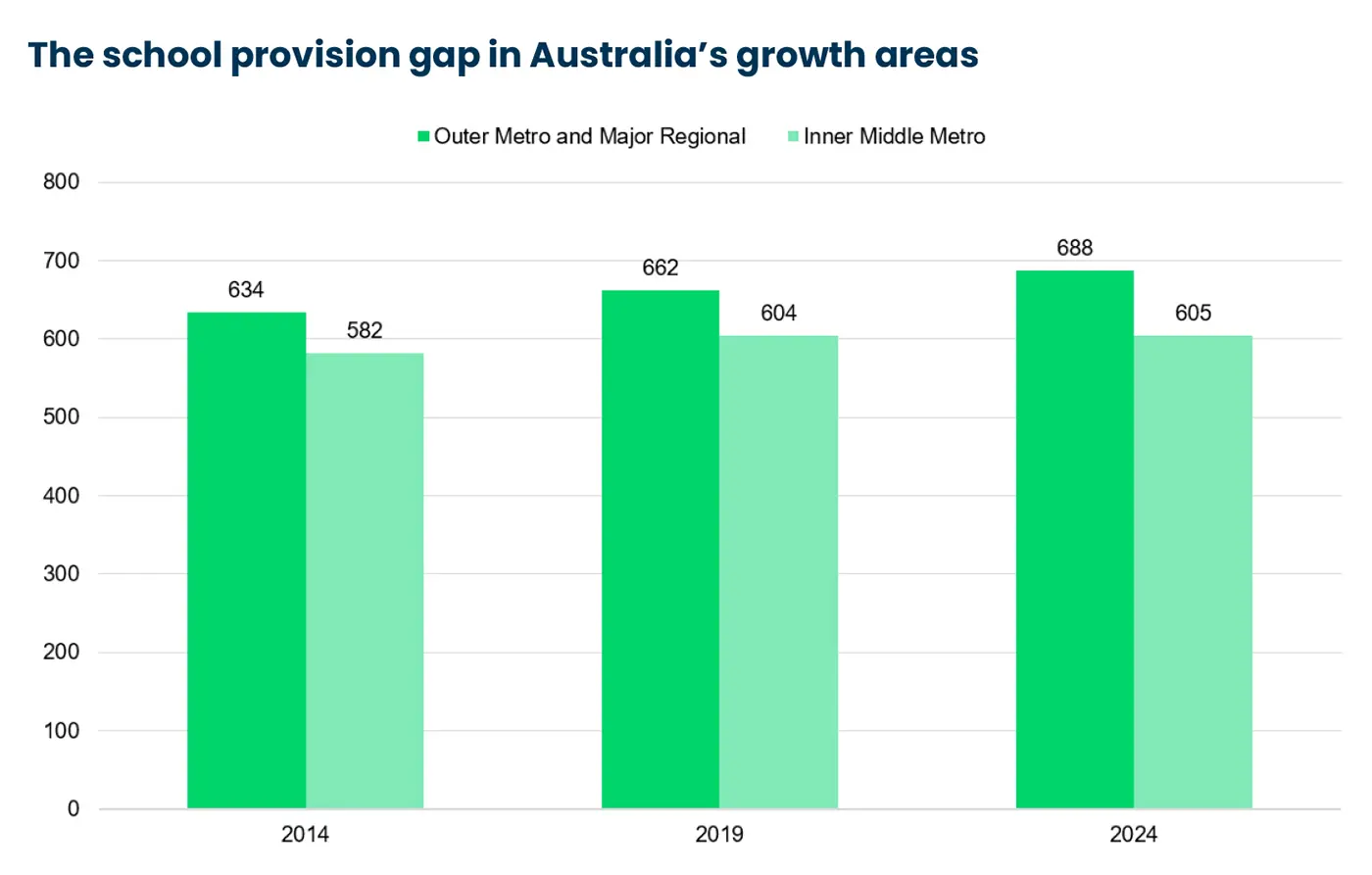
Australia’s growth corridors are absorbing the bulk of national population growth, but school delivery is not keeping pace. Outer-metro and regional city populations grew 2% annually over the past decade, while school numbers grew only 1.1%. For communities this means less choice and bigger waitlists; for schools, it means potential overcrowding and constrained campus space. Growth areas now carry 688 students per school compared with 605 in inner metro areas, equating to a shortfall of around 400 schools nationally.
This gap is not just about demand. Delivery is being slowed by three linked constraints: planning, finance and heritage/site risk. Urbis experts across planning, financial structuring and heritage unpack what is slowing delivery and what education providers can do to improve certainty.
Planning: from indicative sites to committed outcomes
Across Australia, population growth continues to outpace school delivery, while governments face increasing pressure to fund new infrastructure. In NSW, recent budget commitments to 22 new and upgraded schools in priority growth precincts are a positive step. In Victoria, three new schools have been flagged to open in 2028 and $104million committed to acquiring land for new schools in growth areas. In both cases, timely delivery will depend on getting precinct planning right from the outset.
Identifying school sites early and embedding them within accessible local centres is critical to creating connected communities with access to jobs, services and transport. This also requires balancing community amenity with the practical realities of traffic, access and infrastructure sequencing, particularly where residential growth arrives before supporting infrastructure.
This challenge is playing out nationally, although planning mechanisms differ by jurisdiction. In Victoria, Precinct Structure Plans typically identify a limited number of government and non-government school sites within each growth area precinct. In practice, this can create a “winner-takes-all” dynamic, where only one non-government provider is accommodated despite strong demand for educational choice. Similar issues are emerging through NSW Growth Area Precinct planning, Queensland Priority Development Areas and Western Australian Structure Plans, where school sites compete with residential, commercial and other land uses during rezoning.
For non-government education providers, the issue is timing and certainty. Schools need long lead times for acquisition, approvals and delivery, yet site allocations and zoning protections are often treated as optional or deferred decisions. By the time demand is clear, suitable land may no longer be available or financially viable. For providers, securing committed rather than indicative education outcomes earlier in the planning process can reduce land, timing and approval risk.
Non-government education is increasingly part of the solution, with independent sector enrolments continuing to grow ahead of the public system (3.4% growth in enrolments, ABS 2025). Developers are also recognising the value of delivering education infrastructure early as a catalyst for community formation and housing uptake. This creates an opportunity for governments, schools and industry to engage earlier with planning authorities, secure site commitments at structure plan stage and test more flexible or staged delivery models.
Our planning and transport advisory teams are seeing these issues across jurisdictions, including new preschool delivery projects across Newcastle and the NSW Mid North Coast. Urbis has also supported Westbourne Grammar School in Victora advise on establishing a new non-government school in the Geelong growth area.
These projects show that successful education planning depends less on reacting to growth once it arrives, and more on creating certainty early so schools can plan, invest and deliver alongside new communities.
Economics and finance: why the capital model matters
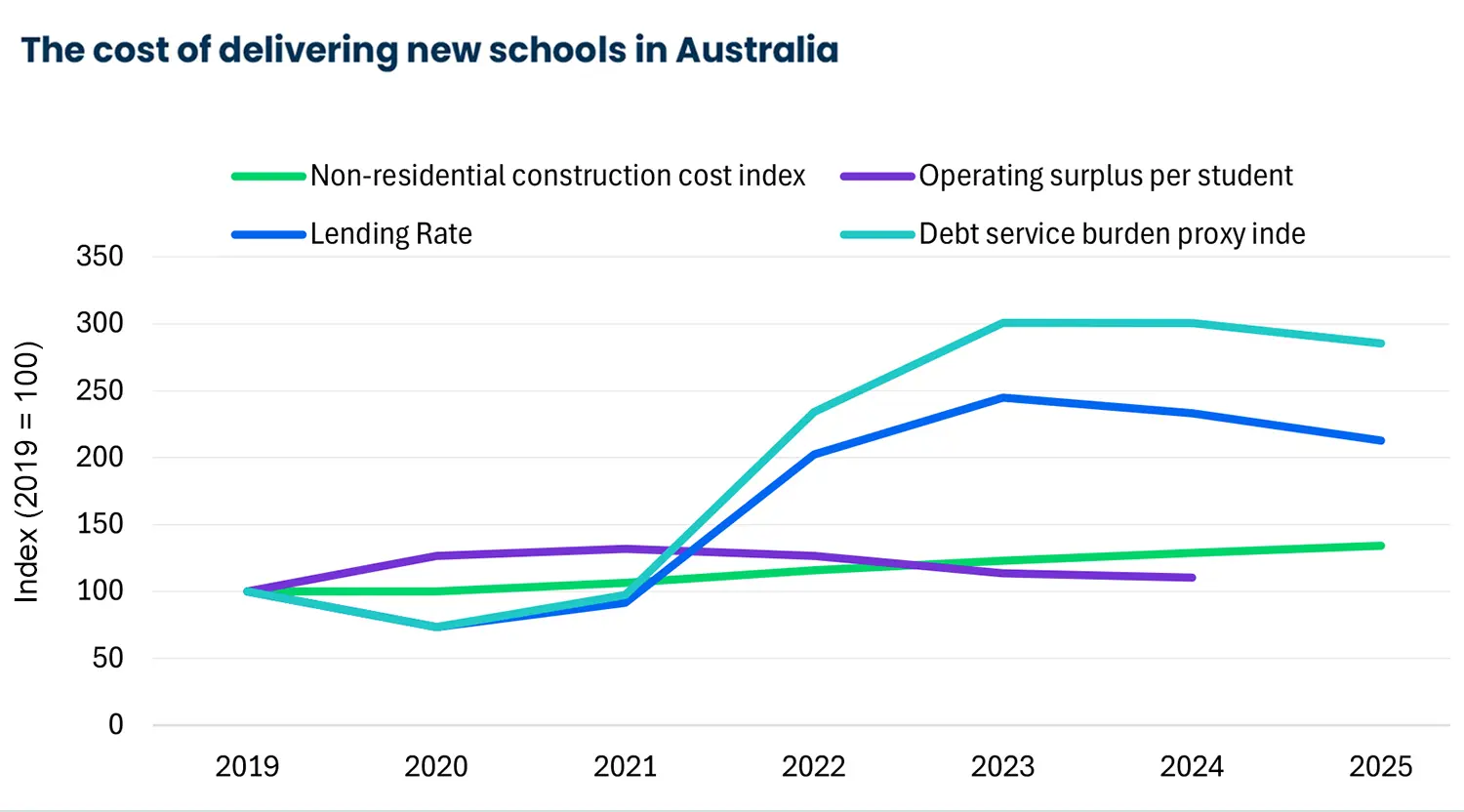
For new schools in growth areas, the financial challenge is no longer just finding a site or proving demand. It is whether the capital model can withstand the early years of operation. Since 2019, non-residential construction costs have increased materially, business lending rates have more than doubled, and operating surplus per student has remained comparatively flat. The sector’s capacity to fund new infrastructure has not kept pace with the cost of delivering it.
Unlike government schools, which are publicly funded and can use Public Private Partnership models to smooth upfront capital costs, non-government schools rely more heavily on debt, balance sheet capacity, parent contributions and capital grants. While grants can be significant, they have not kept pace with rising land, construction and establishment costs.
This leaves schools needing to fund more from their own balance sheets at the point their financial capacity is already stretched. A new P-12 school in a growth corridor may require a total development cost of around $150 million. If 40% is funded through commercial debt and 10% through capital grants, the school still needs to source the remaining $75 million from its balance sheet, parent contributions, donations, sector support or other private sources.
Even if that upfront gap can be bridged, the debt still needs to be serviced. A $60 million loan at a 7% interest rate requires around $4.2 million in annual interest. At full enrolment of 1,200 students, with income of approximately $25,000 per student, a 10% to 15% operating margin produces $3.0 million to $4.5 million in operating surplus, leaving little room under typical lending metrics.
The greater challenge is ramp-up. Growth-area schools rarely open at full capacity, so they carry the capital cost of a full institution while earning income from only part of their eventual student base. The early years, not the steady state, are where the model is most exposed.
This is why traditional build-and-own models are becoming harder to sustain. For non-government schools, lease-to-own, long-term ground leases and developer-landlord structures may offer more flexible pathways, particularly in master planned communities where landholders can help bridge upfront capital constraints. In growth corridors, the funding model can determine whether a school can be delivered at all.
Heritage and archaeology: De-risking the greenfield assumption
Heritage and archaeology can be significant risks for new school projects when treated as late-stage compliance tasks rather than early planning considerations. Despite the “greenfield” label, many growth area sites have layered histories, including Aboriginal cultural heritage connected to waterways, ecology and cultural practices, as well as post-contact rural heritage such as farmhouses, dry stone walls or archaeological deposits. These values can directly influence where and how a school can be delivered.
Early heritage investigations help project teams test whether a site is genuinely deliverable before key commitments are made. They can inform land acquisition, site selection, yield, design, engagement, construction sequencing, program timing and cost. This shifts heritage from reactive compliance to proactive risk management, allowing cultural, archaeological and built heritage values to be considered alongside planning, transport, landscape, engineering and education design objectives.
Approval pathways vary across states and territories, with different triggers, thresholds and consultation requirements. Understanding what investigations are required, when they should occur and how they interact with broader planning and delivery programs can reduce uncertainty for education providers working across jurisdictions.
Best-practice assessments are also moving beyond minimum statutory requirements. In Victoria, for example, Cultural Values Assessments, early archaeological advice and design consultation with Traditional Owners can help project teams understand Country, identify constraints, strengthen design outcomes and build more meaningful partnerships from the outset.
The delivery risk is clear. School projects often operate within fixed funding cycles, tight enrolment targets and compressed construction programs. Underestimating heritage requirements can lead to approval delays, additional technical work, cost escalation and uncertainty around opening dates.
Common delays often stem from limited due diligence before site acquisition or planning, underestimated technical inputs, inadequate allowances for testing or design response, and late engagement with Traditional Owners and heritage specialists.
The strongest outcomes occur when heritage and archaeology are considered early enough to inform the project plan, not disrupt it. Early due diligence provides greater certainty around approval pathways, constraints, program impacts and cost exposure. It also creates opportunities for cultural and historical values to shape site planning, design, interpretation, partnerships and future learning opportunities.
Importantly, heritage and archaeology should not be viewed only as constraints. For schools, they can support more meaningful educational and community outcomes by connecting new campuses with the stories and history of the places in which they are built. Read more here.
For project teams delivering schools in Australia’s growth areas, the message is simple: a greenfield site is not always a low-risk site. Early due diligence, realistic programming and genuine engagement are essential to avoiding delays, managing costs and delivering stronger outcomes for schools and communities.
Turning growth pressure into school delivery confidence
Closing the school delivery gap in Australia’s growth areas requires earlier planning certainty, more flexible capital models and a clearer understanding of site risk before key decisions are locked in. When education infrastructure is planned upfront — alongside housing, transport, heritage and community needs — schools are better placed to deliver with confidence and help new communities thrive from the start.
If you are planning a new school, testing a growth area opportunity, assessing a potential site or seeking greater certainty around approvals, funding or delivery, Urbis can help. Our education specialists bring together planning, economics, transport, heritage and property expertise to shape practical pathways from early feasibility through to delivery.
"Closing the school delivery gap starts before demand arrives."