Reuse of Mining Lands and Coal and Gas-Fired Power Stations in Australia
Client:
Net Zero Economy Authority
Context
Australia’s transition to a net zero economy will necessitate the decommissioning and retirement of mining lands, fossil fuel based infrastructure sites, and coal and gas-fired power stations. While these closures present complex challenges for regional communities, environmental management, and future workforce and skills requirements, this transition creates opportunities for economic diversification, innovation, and long-term sustainable job creation in the new net zero economy.
Our approach
In 2025, The Net Zero Economy Authority engaged Urbis to undertake a research report that provides a structured overview of the policy, legislative and regulatory frameworks governing the rehabilitation and reuse of mining lands and coal and gas‑fired power stations in Australia. Across six jurisdictions (Commonwealth, Western Australia, South Australian, Victoria, New South Wales and Queensland) this project draws on policy, legislative and regulatory analysis, consultation with thirty stakeholders, and six applied key case studies illustrating post-closure pathways. Together, these insights support future planning and the reuse of mining lands and coal and gas-fired power stations.
Key findings
The report produced by Urbis outlined significant key findings:
- Regulatory settings strongly influence what reuse is possible. The future of former mining lands and power stations is shaped less by site potential and more by how policy, regulation, tenure and liability settings interact. Fragmented responsibilities, unclear liability and misaligned planning systems can delay or limit productive reuse, even where communities and investors are ready to act.
- Gaps between closure and reuse create real regional impacts. There is often a long lag between asset closure and new land uses becoming operational. This transition gap affects workers, local businesses and community confidence, particularly where planning for reuse begins late.
- Productive reuse works best when it is place-based. Successful reuse approaches respond to local conditions, infrastructure, markets and community priorities. Early and ongoing engagement with local stakeholders, including First Nations, helps build trust, manage risk and align reuse with local aspirations.
Key learnings from case studies
- Changes to regulatory enforcement and frameworks can influence industry behaviour, supporting more proactive approaches, rather than reactive responses later in the lifecycle. Where planning and zoning settings are more flexible, and approval processes are clearer, site repurposing can progress more quickly.
- Coordinated leadership and the availability of multi-layered incentives can act as catalysts for unlocking private sector investment and attraction by reducing financial risk.
- Early and ongoing engagement with employees, industry, unions and the community, including First Nations peoples, environmental groups, landholders and local residents can ensure smoother transitions.
- Where financial arrangements for closure and rehabilitation are clearly defined and enforceable, transitions are more predictable. Early consideration of funding needs can avoid later delays.
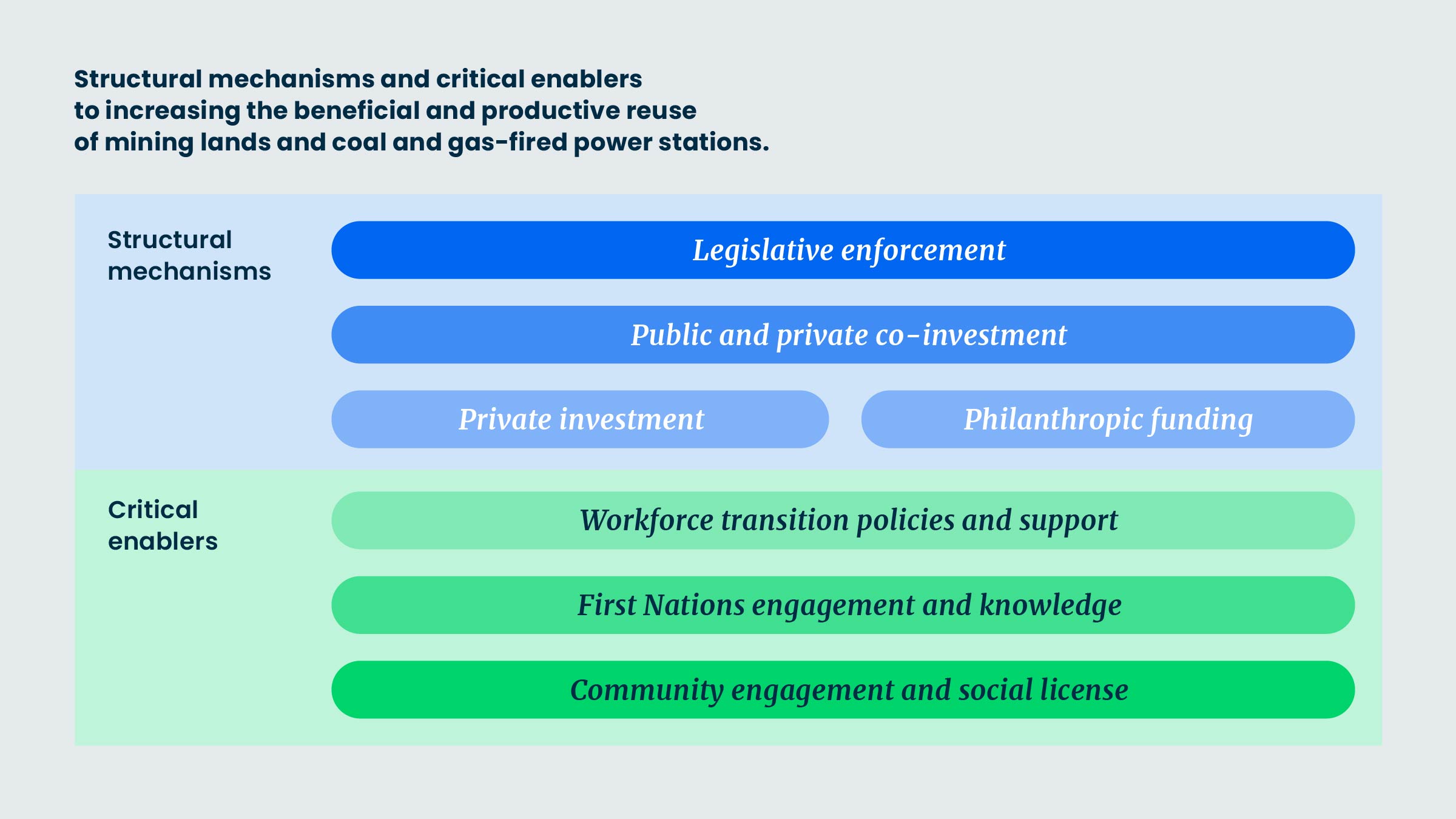
This report builds a clear understanding of how state and Commonwealth policy and regulatory settings enable, or limit, rehabilitation and reuse outcomes. The findings inform the Net Zero Economy Authority’s consideration of strategies and policy settings to maximise beneficial reuse and support a just, sustainable net zero energy and economic transition. As a robust evidence base, this work supports the development of targeted Federal policy to help regions navigate transition, including workforce transition initiatives and asset‑specific resuse opportunities.
Potential Reuses of post closure land uses
- energy and energy-related activities
- industrial or innovation precincts
- agricultural, conservation or land stewardship uses
- First Nations ownership and/or beneficial management
- recreational or amenity uses.
Areas shaping long-term post-closure outcomes include
- interaction between rehabilitation and long-term land use flexibility approaches to managing residual risk over time
- sequencing of closure, rehabilitation and reuse
- governance arrangements that embed First Nations decision-making and economic participation
- coordination across regulatory and planning systems
Read the report
Supported by Norton Rose Fulbright and Indigenous Energy Australia, the project report, and companion reports, are publicly available on the Net Zero Economy Authority’s website. Read the full report here.
This project provides practical insights to support the Federal Government in unlocking beneficial reuse opportunities for mining lands and coal and gas-fired power stations