Unlocking Victorian development with modernised car parking requirements

Victoria’s recent overhaul of car parking requirements marks a significant shift in how development can respond to market demand and site potential, while supporting better transport outcomes. By lowering minimum rates and linking parking provision more closely to public transport availability, the reforms create new opportunities to optimise land use, enhance project feasibility, and deliver more people focused places.
For developers, landowners and architects, the changes open the door to greater design flexibility, streamlined approvals and the ability to reinvest space and capital into higher value outcomes.
The details
In December 2025, significant planning reforms were introduced across Victoria, dividing areas into four categories based on their accessibility to public transport. Statutory car parking rates were updated to better reflect actual demand, with greater consideration given to public transport connectivity.
Category 4 sites have the highest level of access to public transport, while Category 1 sites have the lowest. These categories replace the former Principal Public Transport Network (PPTN) area and are shown on incorporated Car Parking Requirement Maps. The categories are calculated using an algorithm prepared by the Department of Transport and Planning (DTP), based on a similar system that has been used in London for over a decade.
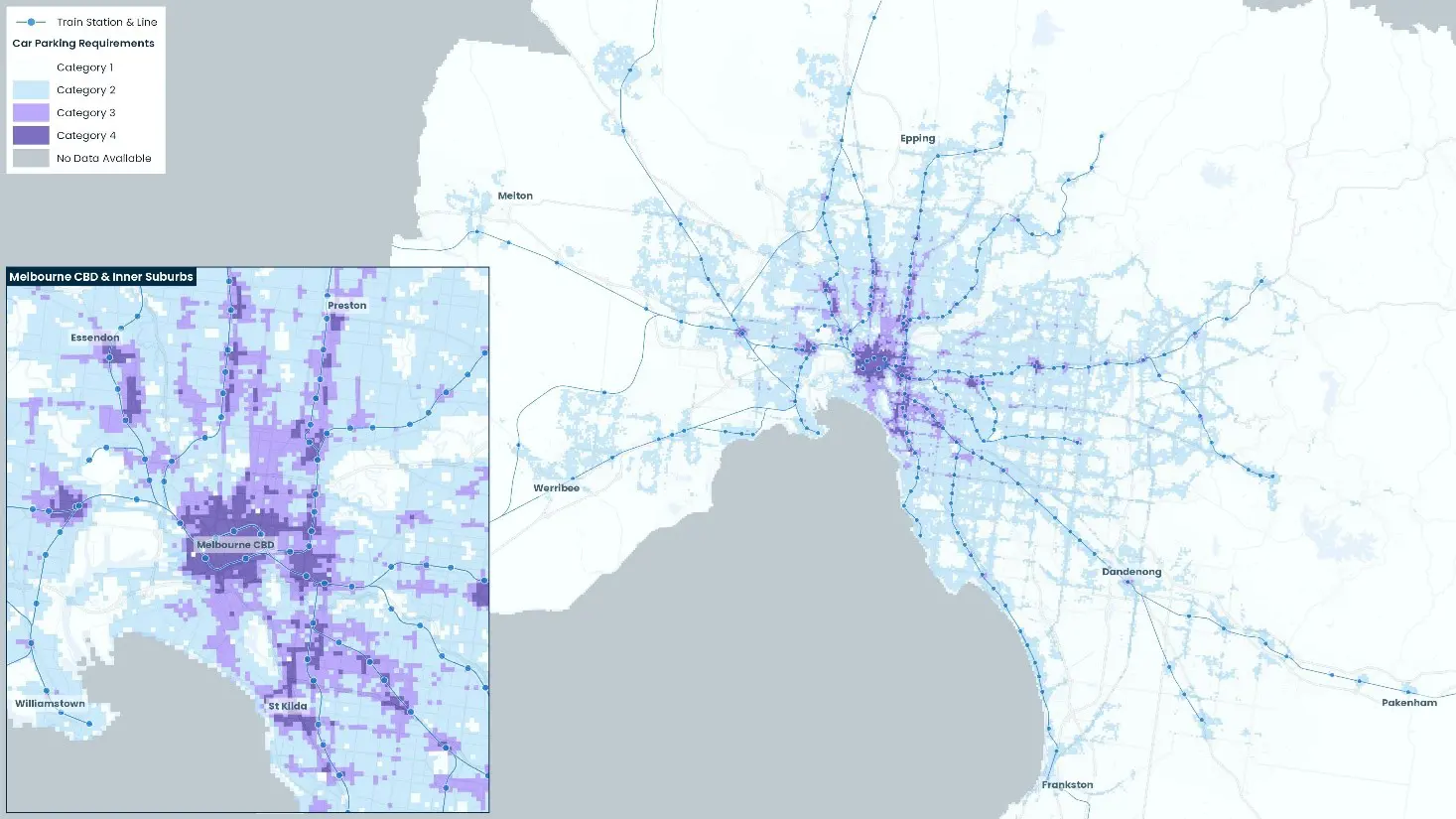
Higher category sites generally have lower car parking requirements due to better public transport connectivity. A comparison of the new and former parking rates for key land uses can be seen in the table below:
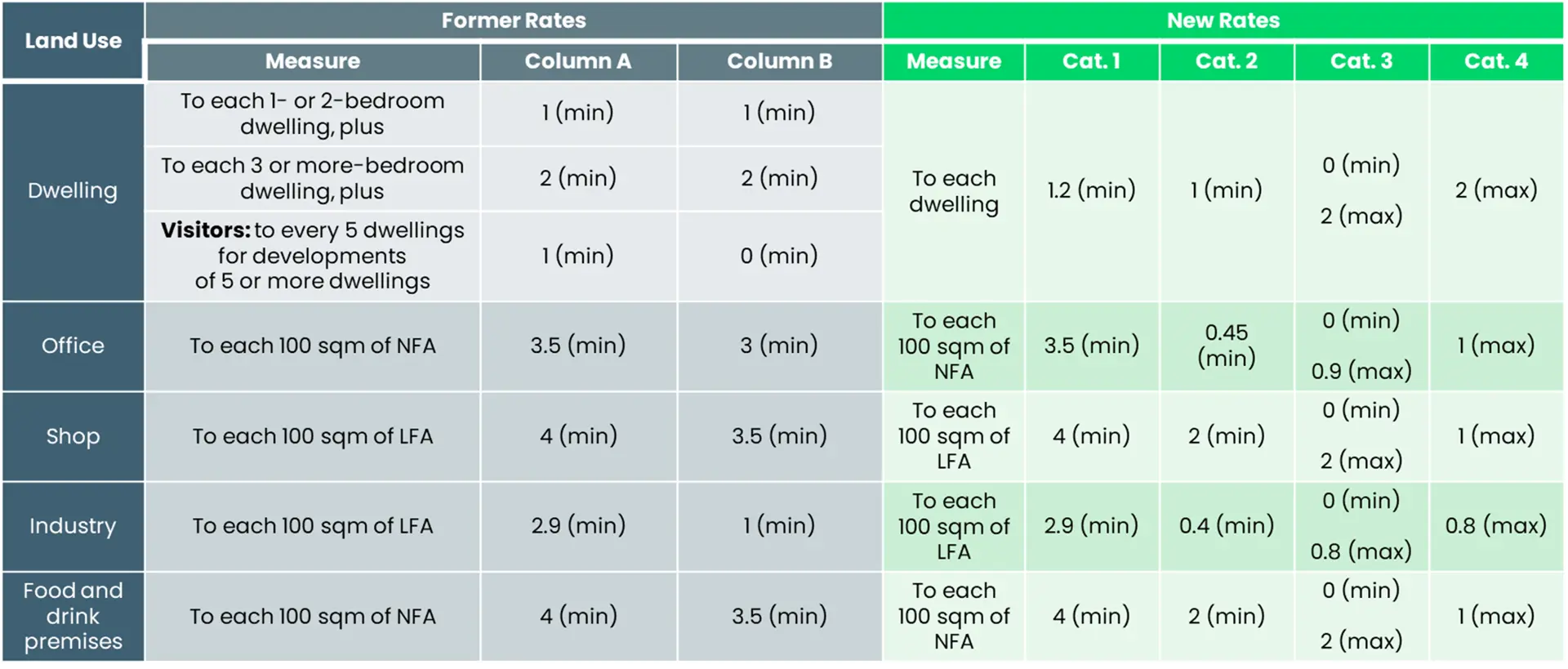
The reforms are designed to better align parking provision with actual demand. For sites with poor public transport access (Category 1), minimum rates remain broadly consistent with previous requirements. However, as public transport connectivity improves, minimum parking rates are reduced, and new maximum limits are introduced.
The reforms also support Victoria’s Housing Targets by significantly reducing the minimum car parking required for new residential development. This will enable more homes to be delivered where people want to live, particularly in infill areas.
So, how might these reforms affect your site?
- Lower minimum parking rates near public transport – most uses with good public transport access can now provide fewer spaces, reducing costs and freeing up site area for other uses.
- New maximum parking rates – sites with excellent public transport access will now be subject to maximum parking rates for some uses. Exceeding these limits will trigger a permit requirement and must be justified to the satisfaction of the responsible authority.
- More developer flexibility – parking provision can be more easily tailored to local demand and market appeal, rather than strict statutory requirements.
- Improved townhouse feasibility – a state-wide reduction in parking minimums for dwellings means more single garages, simpler layouts and better site efficiency.
- More impactful public transport advocacy – annual re-categorisation of sites will reflect any public transport upgrades. This creates opportunities to further reduce or remove minimum parking requirements.
- Removed visitor parking requirement – residential projects are no longer required to provide visitor parking. This will allow for allocation of on-site car parking based on actual demand, maximising efficiency particularly in medium- and high-density developments.
- Streamlined approvals – more pragmatic rates mean fewer permit triggers for car parking, streamlining planning application processes.
- Greater focus on public realm improvements – with reduced car parking there will be a greater focus on improvements to walking and cycling.
The dust is still settling on these significant reforms. For many projects, they present opportunities to reduce development costs, increase design flexibility, and deliver more people-focused outcomes.
Urbis can help you assess the implications for your project, identify strategies to optimise yield and design, and position your development to take full advantage of these changes. Contact our Victorian Transport Advisory team to explore how these reforms could work for you.