Planning new schools in growth areas: three essentials for success


A successful new school campus relies on early market and financial due diligence, clear delivery and funding models, and flexible planning pathways. It is critical for any new campus development to understand how catchment demand, staging, urban design and approval processes influence outcomes. At the same time, the wider social and economic value education infrastructure brings to growing communities needs to be clearly articulated and communicated to ensure a smooth engagement and approval process.
Surging demand for housing and community infrastructure in growth areas around Australia provides a unique opportunity to strategically plan for new education campuses that will grow with, and shape, the community. According to Federal Government projections, Australia will need around 900,000 to 1 million new homes to support forecast population growth over the next five years to 2031. These include approximately 35–40%, or around 320,000 to 400,000 homes, across the country’s greenfield (also known as liveable communities) growth corridors requiring a further 120–130 primary schools and 35–40 secondary schools nationwide to support new communities.
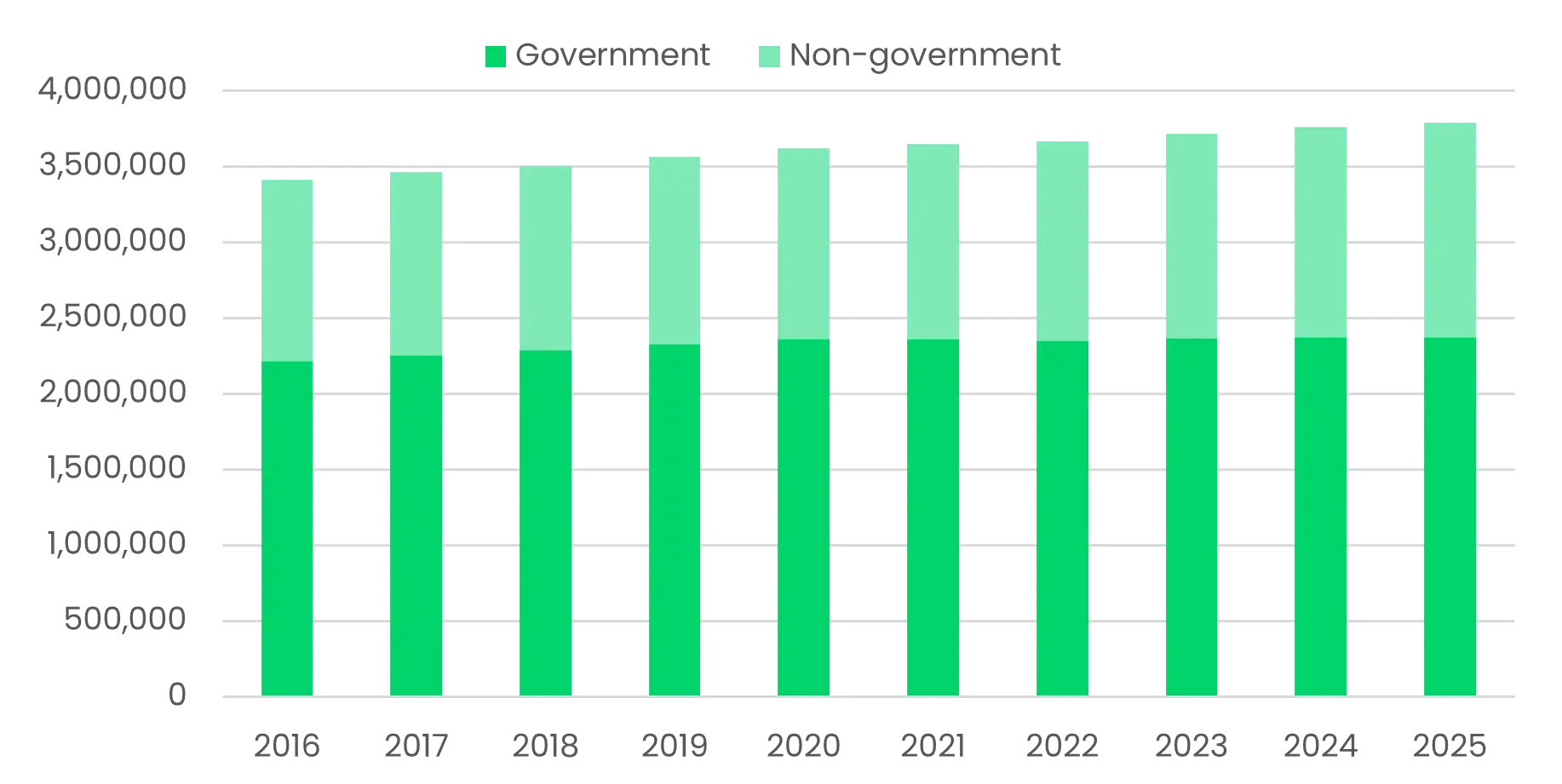
This level of growth creates both opportunity and challenge for education providers and planners, especially for non-government schools, given the clear shift in favour of more diversified school education services (see Chart 1). A successful new school campus relies on early market and financial due diligence, clear delivery and funding models, and flexible planning pathways. It requires a clear understanding of how catchment demand, staging, urban design and approval processes shape outcomes, while recognising the broader social and economic value education infrastructure brings to growing communities.
Here are the critical factors for shaping successful new school campus delivery in Australia, informed by Urbis’ experience with complex school developments.
1. Setting the foundations: Strategic Planning and Market Due Diligence
Delivering a new school campus involves significant capital, long timeframes and market uncertainty, making early, thorough due diligence essential to inform investment decisions and long term operational success.
Strategic Planning & Development Feasibility
A new school development begins with establishing project feasibility. Urbis’s involvement in these feasibility investigations centres around a multi-disciplinary approach which includes the following key considerations:
- Site identification. Consideration of transport connectivity, infrastructure accessibility, planning alignment and zoning.
- Catchment size. Capacity to support early enrolments, the timeframe to reach target capacity, and the impact of demographic change on enrolments over time.
- Competitive landscape. Identifying local competition and supply/demand gaps to inform optimal size and scale.
- Financial feasibility. Beyond land costs and levies, fee affordability shapes revenue, making long term financial feasibility critical.
- Strategic positioning and advocacy. Once a site is selected, advocating for education land use early in growth area planning is critical.
- Delivery model. Including infrastructure delivery responsibility, funding arrangements and opportunities for strategic partnerships.
- Development staging. A delivery approach aligns services with demand, reduces upfront capital commitment and improves cash flow.
Social and Economic Impact
In most cases, education developers are required to demonstrate the social and economic impact associated with a new campus or facility development. This can include:
- A ‘need’ statement establishing the community need and demand for a new facility.
- Jobs creation and economic contributions during the construction phase and on an ongoing basis, direct and indirect.
- In greenfield areas, schools are also a strong draw card that support the activation of housing development and the broader local community when delivered early.
- Importantly, school and other education infrastructure can deliver broad-based community and social benefits beyond the dollar value impact. Read ‘Beyond the bell: schools serving the community'.
Ensuring such benefits are identified upfront and clearly communicated to the approval authority and critically the local community can facilitate a smoother planning approval process.
Case study
Urbis has been supporting Westbourne Grammar School with their strategic advocacy for the inclusion of a non-government school campus within a future Precinct Structure Plan in Lovely Banks, Geelong. Our submission demonstrated the strong demand for diversified education in supporting the future community within Geelong’s next growth frontier. Critically, the various forms of social and economic benefits associated with the delivery of a new private school campus were clearly articulated in a greenfield context.
2. Urban design for flexible and future-ready schools
Best practice urban design for education infrastructure focuses on getting the fundamentals right from the outset, ensuring facilities are well located, delivered at the right time, and designed to adapt as communities evolve. These principles are explored in detail in Future Liveable Communities report with key insights for schools below.
Location
The location of a school, early learning centre or any educational facility within a new community is critical. Key site selection criteria include:
- Accessibility to walking, cycling and transport networks
- Distance to planned open green space
- Adequate land to allow for future growth
- Environmental considerations like biodiversity and flooding
Pacing
The staged delivery of education infrastructure should match the pace of delivery of residential lots (and the associated population growth). Education facilities are a draw card for home buyers, making timely delivery of infrastructure crucial. Developers can work with government agencies, private operators and local councils to ensure delivery is appropriately staged by:
- Frequently reviewing forecasting for lot delivery and community growth to track trends against original projects
- Looking at surrounding community capacity and listening to community feedback on need for school facilities
Adaptability
Education infrastructure should incorporate flexibility to allow for expansion or adaptation as the community grows and changes, including multi-purpose spaces and adaptable learning environments.
In greenfield areas, schools often play a broader social and community role. As such:
- Planning should ensure facilities can be used beyond school hours
- Facilities should support social connection beyond the school community through sport, recreation and community events
- Community infrastructure, such as pools and performing arts spaces, should be considered and made available to the wider community
Beyond community connection, these facilities may also provide alternative income to assist with running and maintenance costs.
3. Planning pathways for timely school delivery
An integral part of school establishment is a planning pathway which facilitates, rather than obstructs, approval for schools. While planning pathways differ from state to state, the ideal pathway should include the following key factors.
Flexibility in Staging, Construction and Design
The ideal planning pathway is a singular application which can accommodate master planning, long-term visioning and flexibility in delivery and design/layout. Approved plans can set broad development envelopes rather than detailed designs, preserving flexibility in how infrastructure is ultimately delivered.
In Queensland, this flexibility is achieved through the Ministerial Infrastructure Designation (MID) process, which enables a single, streamlined approval framework to support large‑scale, staged infrastructure delivery while retaining flexibility in design, layout and timing.
Potential for performance-based outcomes
The ideal planning process allows the Applicant to present outcomes which do not strictly align with the planning scheme but remain compliant with industry-best practice. This can mean greater height or more innovative built form outcomes such as vertical school models and integrated indoor/outdoor spaces in lieu of the traditional model of separated General Learning Areas (GLAs) and outdoor play space.
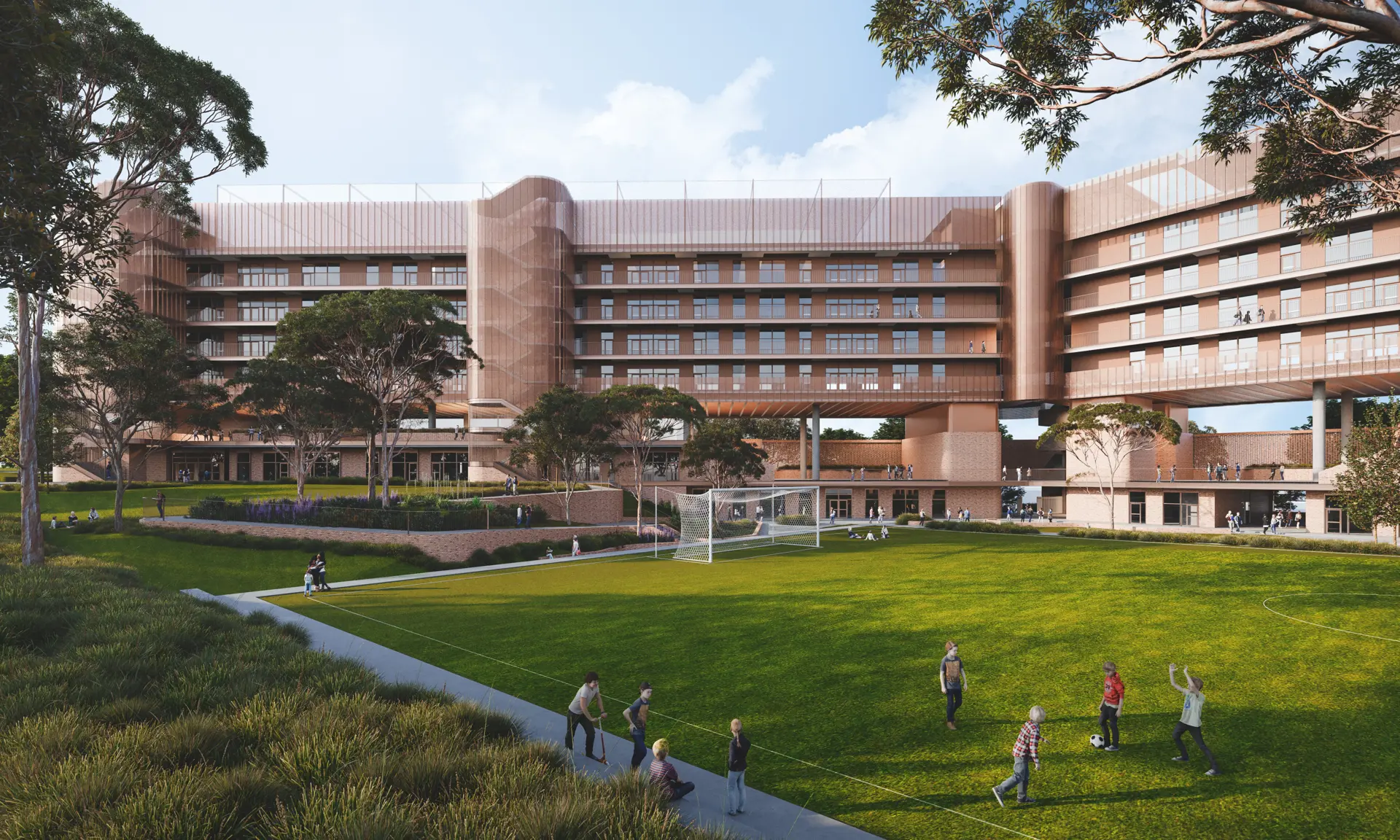
Urbis was engaged to design a series of innovative play and learning spaces for a new urban school Macquarie Park New High School, in Macquarie Park, NSW. The design incorporates a MiniRoos-sized sports field, terraced pathways, a sensory garden, a kitchen garden, open lawn areas, two large Covered Outdoor Learning Areas (COLAs), rooftop courts, and a rooftop library seating space. A culturally grounded, flexible and inspiring school environment that supports active play, outdoor learning, and community connection.
Community Objections
A strong planning application for a school should be comprehensive enough that it enables a clear and final planning decision with no ongoing scope for community objection (for example the ability for the community to seek to overturn an approval via third party appeal rights). By thoroughly addressing the economic and community impacts, demonstrating compliance with planning policy and clearly articulating the public benefits, the application provides decision makers with the confidence to approve the proposal decisively. This certainty is essential given the urgency of delivering school infrastructure to serve growing communities, where prolonged objections or third party appeals can undermine timely access to education and broader community wellbeing.
Case study
Victoria’s State Government pathway for non-government schools , while still including advertising, removes third party appeal rights. A permit is also often achieved in less than 6 months, rather than the longer timeframe under Councils and VCAT of up to 18 months.
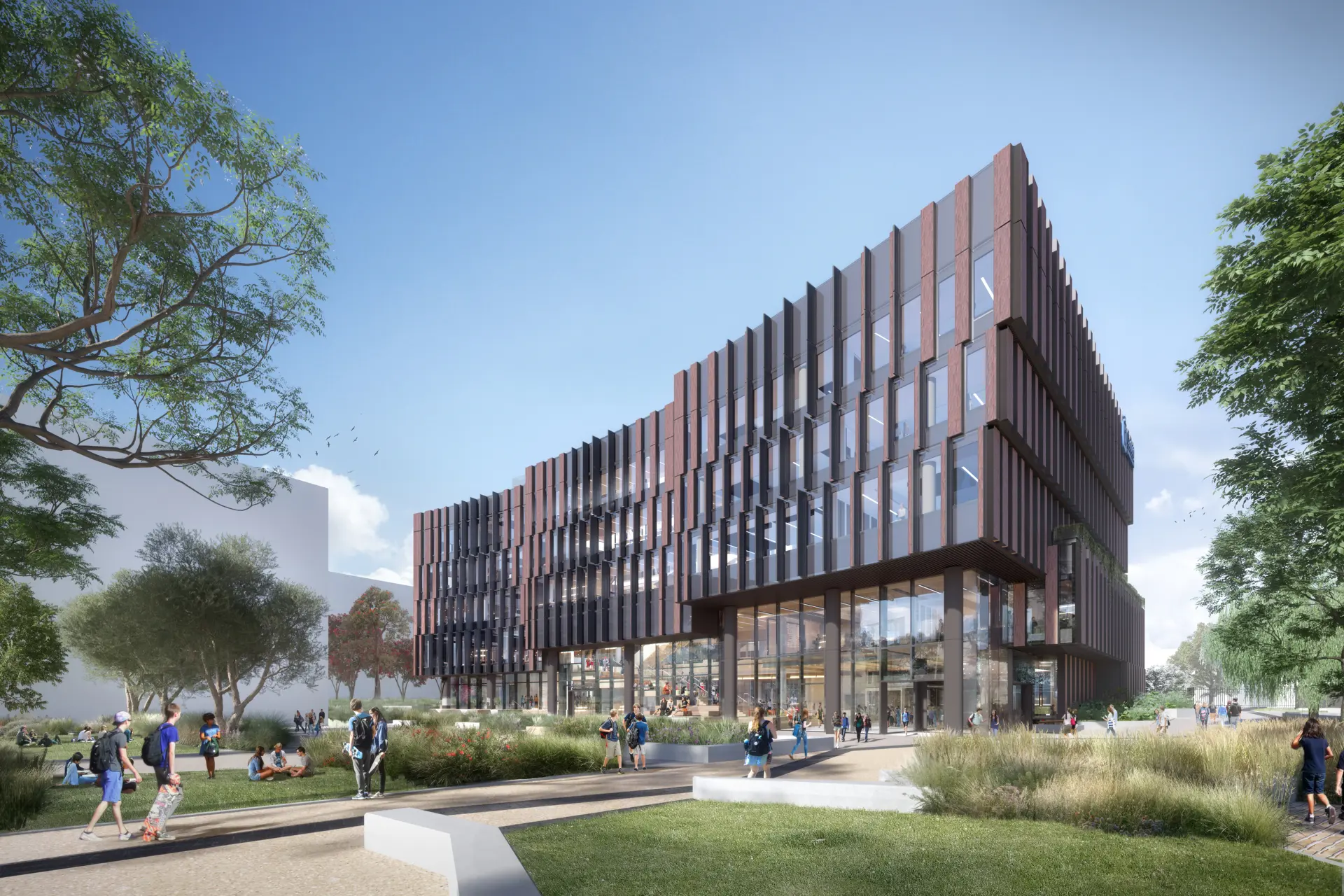
Caulfield Grammar School – Caulfield Campus was one of the first projects to test out this process, with Urbis securing planning approval for a 5-storey teaching and learning building in a substantially consolidated assessment timeframe. By working closely with the client and State Government, Urbis was able to assist the school with navigating a new process which ultimately led to decreased risk, saved costs (through an expedited assessment process) and provide valuable feedback to the Government on their new policy. Notably, the project was also shortlisted for an Excellence Awardee for the Australian Education Awards 2025 – Innovation in Learning Environment Design.
Surging demand for housing and community infrastructure in growth areas around Australia provides a unique opportunity to strategically plan for new education campuses that will grow with, and shape, the community
Australia’s growth corridors present a rare chance to plan ahead for new school campuses which meet the needs of an evolving and rapidly growing community and align with the constantly evolving learning ethos and business models of schools.
We are proud to work with our school partners to deliver education infrastructure that supports thriving communities, and we welcome the opportunity to discuss how this thinking could support your project.