Connecting housing supply with infrastructure delivery


The Productivity Commission’s interim report on regulatory barriers to housing supply has already prompted strong debate on planning reform. That debate matters. But from my perspective, the most important section is infrastructure coordination and funding.
The report rightly recognises that rezoned land can sit unused for years when enabling infrastructure is not funded, sequenced or delivered at the right time. I see this problem play out often: land may be technically available, but not serviceable, feasible or ready to support homes.
That is the focus of this article.
Buying a house without knowing the price
Rezoning decisions are too often made before the true cost of planned infrastructure is understood. It is important to recognise contributions do not capture all infrastructure costs – particularly so in infill areas. Rezonings may identify the infrastructure required, but not always the actual cost, funding from each pathway or responsibilities across government.
That creates avoidable risk. Costs can be underestimated, land acquisition requirements can escalate, and funding gaps can emerge after land has been rezoned, values have shifted and expectations are set. Growth is best planned when infrastructure costs, funding sources and residual gaps are known upfront.
Recommendation 1: Prepare an Infrastructure Cost Budget before rezoning
An Infrastructure Cost Budget should be prepared before land is rezoned.
This budget should identify the full cost of infrastructure required to support the rezoning, the proposed funding source for each item and any residual gap. A rezoning should only proceed where unfunded infrastructure exposure is acceptable.
The link between contributions and feasibility
Infrastructure contributions affect feasibility differently depending on the market. In stable markets, known contributions should be reflected in land values. In new release areas, contributions may be unresolved, policy may still be shifting and landowner expectations can sit ahead of actual feasibility.
The new Aerotropolis precinct being built around the new Western Sydney International Airport shows how this plays out. The precinct was rezoned in 2020, yet new biodiversity contributions were still being announced six years later. Urbis had anticipated a contribution was likely and prepared clients for that risk, but the rate was not known until it was announced.
Stormwater contributions also shifted materially — from around $300,000 per hectare to close to $1 million per hectare. When transactions do not occur with informed costs, development is delayed and fewer homes are delivered when they are needed most.
Recommendation 2: Exhibit all infrastructure contributions with the rezoning
All infrastructure contributions should be exhibited with the rezoning, including local and regional contributions, utility charges and affordable housing contributions. Land transactions need clear development costs; without that transparency, feasibility problems begin before the first DA is lodged.
But what about the landowners?
Landowners who benefit from upzoning need a clearer way to contribute to the infrastructure that supports that uplift, without creating barriers to development. NSW considered this in 2021 through the proposed Land Value Contribution, a model similar in intent to Victoria’s Growth Areas Infrastructure Contribution.
The proposal had design flaws, including the 20% cap on rezoned land value and use of Valuer General land values. Poor communication also made it sound like 20% of people’s land would be forcibly acquired, and the backlash was significant. Those issues were explored at the time.
Still, the model recognised a necessary principle: infrastructure costs should be shared more fairly between those who benefit from uplift and those who deliver housing.
Recommendation 3: Revisit Land Value Contributions for rezoning areas
A refined Land Value Contribution model should be reconsidered for major rezoning areas in all states (Victoria already has the GAIC), building on the NSW proposal while addressing its design issues. Done well, it could better spread infrastructure costs sharing across all beneficiaries, reduce pressure on development-stage contributions and help councils manage land acquisition costs earlier.
Are we over-relying on developer contributions?
Across Australia, contribution systems differ — from Queensland’s LGIP infrastructure charges to Victoria’s DCPs, ICPs, open space contributions and GAIC, and NSW section 7.11 plans, section 7.12 levies, DSPs and the HPC — but all of these contributions have the two same design flaws:
- Capturing fair contributions from all beneficiaries
- Collecting funds before infrastructure is needed.
Regional infrastructure such as sub-arterial roads, sewer treatment plants, recreation centres and major social infrastructure can serve large catchments for decades, supporting both greenfield and later infill growth. The question is whether contribution systems are carrying too much regional infrastructure, and what financing tools could better match its scale and timing.
Infrastructure bonds are already used to fund major infrastructure, including toll roads, bridges and sewerage. Why not use them for urban enabling infrastructure?
Recommendation 4: Use infrastructure bonds for regional enabling infrastructure
Infrastructure bonds, or similar structured financing models, could help fund sub-arterial roads, sewer treatment plants and recreation centres serving catchments across multiple suburbs.
This would reduce pressure on contribution systems that rely on forecast costs rather than tendered prices, and limit funding gaps too often left with local councils.
The timing issue
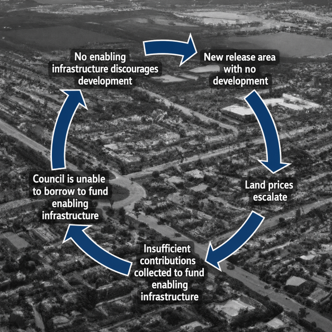
Contributions do not deliver enabling infrastructure on time. Early Development needs infrastructure now, not the promise of infrastructure later.
State and federal grants are important, but they are often ad hoc and not always aligned with best-practice infrastructure planning. New release areas need a more predictable funding model.
Recommendation 5: Seed funding for enabling infrastructure in every new release area
State and federal governments should provide seed funding for key enabling infrastructure in new release areas, with partial repayment through land and works contributions as precincts develop.
This would address the timing problem and reduce the first-mover disadvantage identified by the Productivity Commission. Early development in priority precincts should be supported, not penalised for carrying early delivery risk.
Contributions payment at occupation and local government borrowing
Shifting contributions to occupation stage is a practical reform in a tight lending environment, but it may create cashflow challenges for councils.
Those challenges could be managed if councils were able to borrow against forecast contributions income, with appropriate safeguards. Earlier infrastructure delivery supports development, which then helps forecast contributions be collected.
Recommendation 6: Allow contributions income to be recognised in council debt capacity and contributions are paid at occupation stage
Forecast contributions income should be considered in councils’ debt cover ratio calculations, with appropriate safeguards. Once borrowing capacity is less constrained, contribution payments should be deferred to occupation stage.
From planned capacity to delivered homes
The Productivity Commission has put a welcome spotlight on infrastructure funding and coordination. In my view, the interim report does not provide all the answers, but it clearly identifies the reform directions needed to connect land release with infrastructure funding, sequencing and delivery.
Land release only matters if land is serviceable, feasible and supported by infrastructure. Otherwise, we are creating paper capacity, not housing supply.
Urbis will prepare a submission to the Productivity Commission, due by 30 September 2026, and welcomes perspectives from those working across planning, development, infrastructure, utilities, local government and state government.
I am particularly interested in practical ideas that move us from planned capacity to delivered homes, so please reach out.