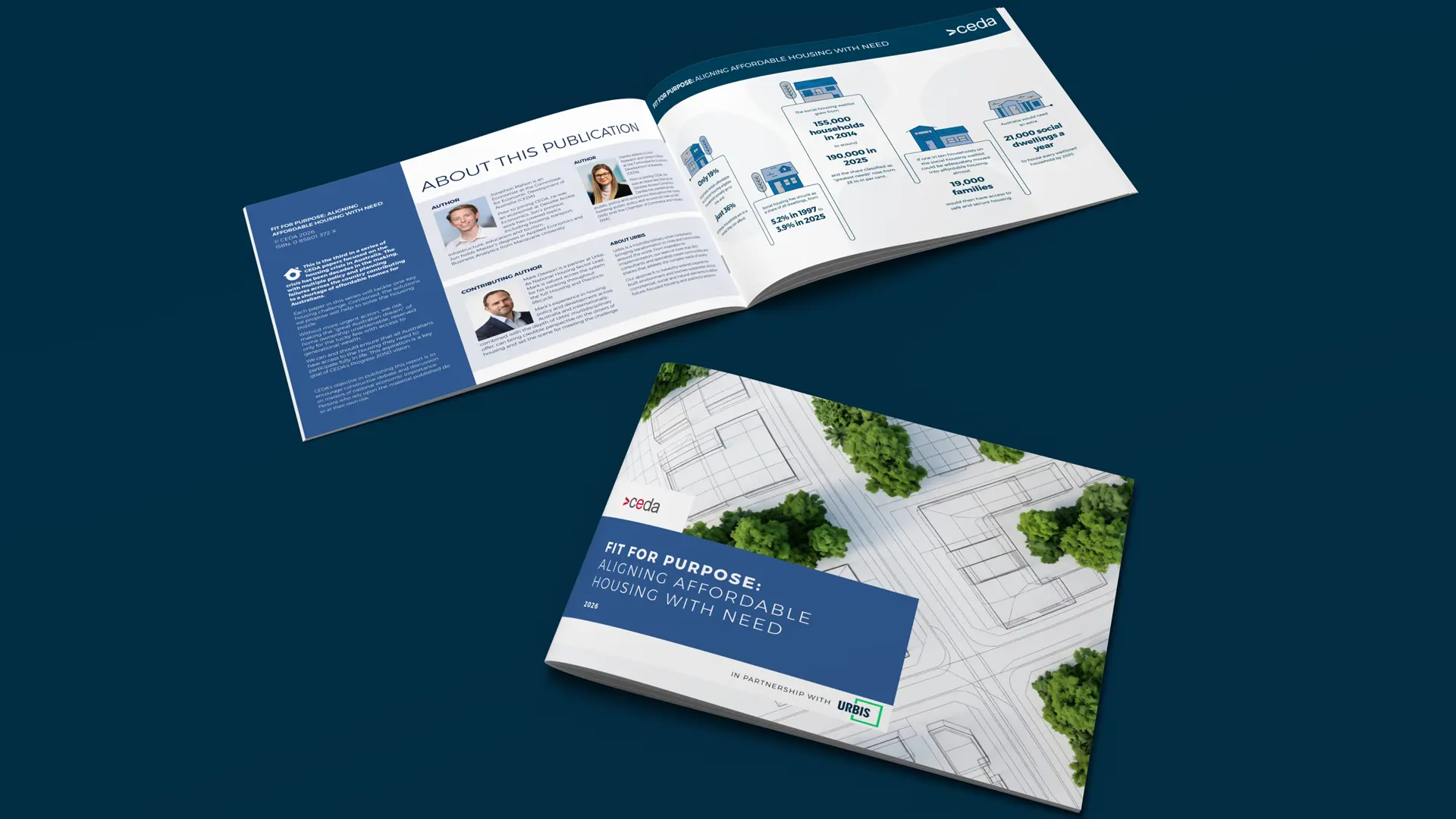
New report from Urbis and CEDA calls for a more fit-for-purpose affordable housing system
Published: October 22, 2026

A new report by the Committee for Economic Development of Australia (CEDA) produced in partnership with Urbis examines Australia’s affordable housing system and how it can better serve those who need it most.
The report, Fit for Purpose: Aligning affordable housing with need, finds that Australia’s social and affordable housing is increasingly struggling to support lower-income households. While social housing has shrunk from 5.2% of total dwellings in 1997 to 3.9% in 2025, the waitlists have increased from 155,000 households in 2014 to 190,000 in 2025.
The Urbis team has elaborated upon these recommendations outlined in the report in our companion piece, Defining affordable housing: a framework for delivery at scale, arguing that a nationally consistent framework that distinguishes between social, low-income, affordable, and moderate-income affordable housing will enable industry providers to support lower-income households.
As access to social housing becomes more constrained, more households are being pushed into the private rental market, where we’ve seen an increase of 48% in advertised rentals over the past decade. One in five renter households are experiencing financial stress.
“A home isn’t simply affordable because it’s cheaper than the market. If the rent is still beyond the reach of the household it is meant to support, then the system isn’t working. A nationally consistent approach would give Australia a much clearer foundation for delivering housing where it is needed most, and for targeting investment,” Mark Dawson, National Housing Lead at Urbis.
The report outlines the below key recommendations for government and industry to improve housing outcomes:
Governments should create stable and consistent funding to increase the provision of social housing and reduce pressure on the social housing waitlist
The Federal Government should further increase the rate of Commonwealth Rent Assistance to better reflect contemporary rents paid.
Introduce bond loan schemes and rental guarantees for households on the social housing waitlist.
State governments should facilitate and incentivise institutional landowners to deliver social or targeted Affordable housing on their own sites.
Increase density uplift allowances for the inclusion of well-targeted Affordable and social housing, or cash-payments funnelled directly to the provision of new social housing.
State governments should fast-track approvals for developments that include social and Affordable housing.
The Australian Institute of Health and Welfare should publish consistent data on the stock and occupancy of Affordable dwellings.